With the recent release of GPT-5, I’m amazed by the incredibly rapid development of generative AI in just the past couple of years. I do think, in many aspects, there are countless flaws and problems in these systems and that human intervention and verification are crucial for all kinds of work as of now.
I wondered what human consciousness really is and how humans would differentiate themselves from artificial intelligence going forward. Just as the August heat and my irrepressible worries were getting to my head, I decided to go on a little walk. Nothing better to relieve my anxiety than walking to a bookstore, plopping down on the carpet and reading a book on calculus under the AC.
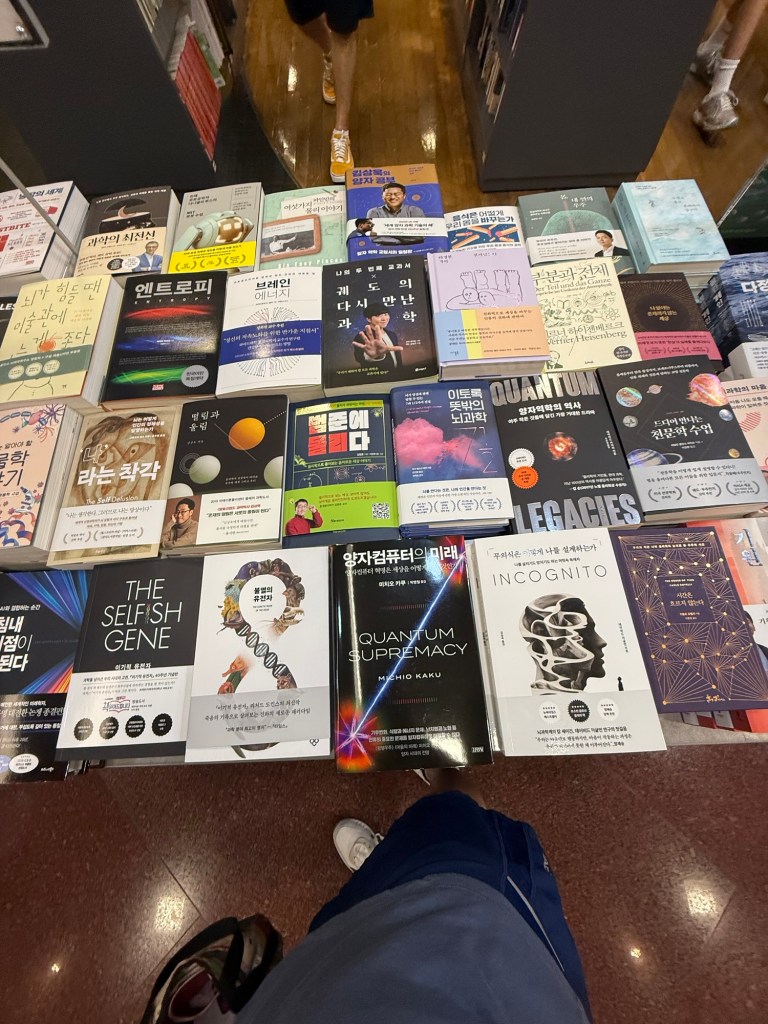
Bookstores are one of my favorite places to wander around in. I found a book titled “<Calculus: How Calculus Makes the World Smarter>” by Hwataik Han, written in Korean. Calculus seemed niche enough for it to be a thing of the math and physics worlds exclusively. Looking through the table of contents, a chapter about artificial neural networks stood out to me.
And so I read! A statistical algorithm modeled off of our very own brains, artificial neural networks are intricate systems composed of layers of nodes connected by various transfer functions. Information is passed from node to node through transfer functions, their influence on the output being amplified or muted through weights. Using ANN, AI can “think” and make decisions like humans would. Like teaching a student, supervised learning would be a method of training the AI by repeatedly correcting its output until the model “learns” the patterns. Unsupervised learning would be the AI self-studying these patterns through clustering, or grouping data based on similarities and characteristics, and finding association rules on its own. Clustering can be visualized on the coordinate plane, where the smaller Euclidean distance between data points signifies a closer similarity. The model would then group data points in close vicinity as one, and thus can make learned decisions even with novel datasets.
It intrigues me how similarly our brains process information to computers. By sending electrical signals from one neuron (or node in computer terms) to another, both ultimately yield results based on the interactions, amplification, or the resistance against these signals. Yet, Han points out how despite the action of identifying cats being simple to humans, it’s a very complicated process for computers; while on the flip side, large number computation requires much time for humans, but can be done almost instantaneously by computers. The many differences between our brains and computer processing, including their architectures and structures, reminded me of what I learned in the Data Structures and Algorithms class last spring.
It stood out to me how we mimicked the system of our brain and our own learning process in the development of AI and “thinking” computers. Despite how similar the process might be, it’s us humans, it’s something about life that enables the formation of opinions, consciousness, and identity, that AI cannot dare replicate. Or maybe not yet.
 Scientific Narrative
Leave a comment