This post introduces the works of 2025 Nobel Prize Laureates, related to the physical sciences. This article will be covering the Physics, Medicine and Physiology prizes, and Chemistry prize-winning works. The radio show was aired on WPEA 90.5 FM on October 15, 2025 for Physics, and October 22, 2025 for Physiology/Medicine and Chemistry.
Link to Google Drive of Aired Radio Episodes: https://drive.google.com/drive/folders/1kZOZyPyAe2lq0MhM_X5mXOKKbMKDkD6P
Physics
The 2025 Nobel Prize for Physics was awarded to John Clarke, Michel H. Devoret, and John M. Martinis “for the discovery of macroscopic quantum tunneling and energy quantization in an electrical circuit”.
Their work expands upon our current understanding of quantum mechanics. In our everyday lives in the macroscopic world, the idea of quantum superposition, but it’s a hard concept to grasp. Rules of classical physics don’t exactly apply in very, very miniscule settings, like in atomic or subatomic particles.
A common analogy we hear is of Schrodinger’s cat, where the cat in a box is said to be both “alive” and “dead” until the box is opened and the cat is observed.
An instance we see “Schrodinger’s Cat” in the quantum world is light. Light is both a particle and a wave, a simultaneous fact that’s hard to reconcile. Or another example: you can’t simultaneously determine the exact position and speed of an electron due to the Heisenberg Uncertainty Principle. In little worlds, physics seems to disobey its most fundamental laws.
We thought these quantum laws were exclusively observable only in minuscule, subatomic settings… until Clarke, Devoret, and Martinis discovered that these rules of quantum mechanics can be observed in larger systems that can be held in hand, contrary to our conventional beliefs.
According to the Popular information section of the nobel prize website (https://www.nobelprize.org/prizes/physics/2025/popular-information/), the three scientists “built an electrical circuit with two superconductors, components that can conduct a current without any electrical resistance. They separated these with a thin layer of material that did not conduct any current at all. ” Through this, they discovered how all the particles within the particle behaved in unison. Popular information further quotes “as all the particles within the system act in unison where the electrical current flows without a voltage, they observed quantum tunneling when a small part of the escaped the zero-voltage state, and they observed voltage.” In other words, they observed “quantum tunneling” where electrons popped through the barrier thin layer of material, a phenomenon that was thought to be only possible in microscopic settings, on a much bigger level.

Why is their work so impressive? They observed the laws of quantum mechanics in a macroscopic scale, where an observable event of voltage generation occured. Going back to example about the Schrodinger’s cat, physicist Anthony Leggett commented on the three scientists’ work and how they demonstrated the paradoxical absurdity in the Schrodigner’s cat thought experiment to be not a totally irreconcilable mode of thought; they demonstrated that quantum physics can be in fact observed in a macroscopic world as well.
Their discoveries are opening pathways for advancements in quantum computing, developing quantum systems and technologies, enlightening not only the academia but forerunning a new era of technologies as well.
Physiology/Medicine
The Prize for Physiology/Medicine was awarded to Mary E. Brunkow, Fred Ramsdell, and Shimon Sakaguchi for their contributions to the findings of “peripheral immune tolerance.” They discovered regulatory T cells, immune cells that identify foreign microbes, such as bacteria and virus that look vastly different or even sometimes resemble human cells. Before their discoveries, T cells have been known to monitor, alert, and kill cells that have been affected by pathogens. When a T-cell mistakenly alerts other immune cells that a pathogen has been found, regulatory T-cells suppress immune alert signals, making sure that T-cells are not attacking human cells.
The scientists expanded upon the conventional knowledge of central immune tolerance, where dangerous, self-reactive immune cells preliminarily deleted in the thymus, through the idea of peripheral immune tolerance, where inaccurate immune system alerts by T-cells already in circulation of the body are suppressed. Sakaguchi discovered the “calming” function of T-cells, and soon afterwards, Brunkow and Ramsdell located the Foxp3 gene, which caused a self-attacking mutation in mice’s immune system in their experiments. Once the connections between the discoveries were made, the scientists were able to confirm the existence and functions of regulatory T-cells.

For possibly malignant tumors, many regulatory T-cells can be found near the tumor. For cancer research, researchers are exploring how they can breach this barrier of T-cells to make sure that malignant tumors are attacked by T-cells when necessary. On the contrary, in cases where more regulatory T-cells are needed, for example for patients that have autoimmune diseases, researchers are finding ways to increase the production of regulatory T-cells in the body. Furthermore, researchers are exploring how regulatory T-cells can make stem cell transplants safer, to make sure that donor cells do not recklessly attack and impair the patient’s immune system.
Chemistry
The 2025 Nobel Chemistry Prizes were awarded to Susumu Kitagawa, Richard Robson, and Omar M. Yaghi for the creation of the “first metal-organic frameworks (MOF)” that can be practically applied in the world.
Robson was initially inspired by the wooden ball and stick model used in university chemistry settings. As he was drilling holes into wooden balls, that represent individual atoms, we wondered how the tendency of some atoms to be more attracted to others could factor into the organization of a large molecule.
When Robson arranged positively charged CU2+ ions into the molecular construction of a diamond, a crystalline organization, he noticed how there were large holes between different parts of the molecule upon arranging itself. Through these cavities different chemical substances could move.
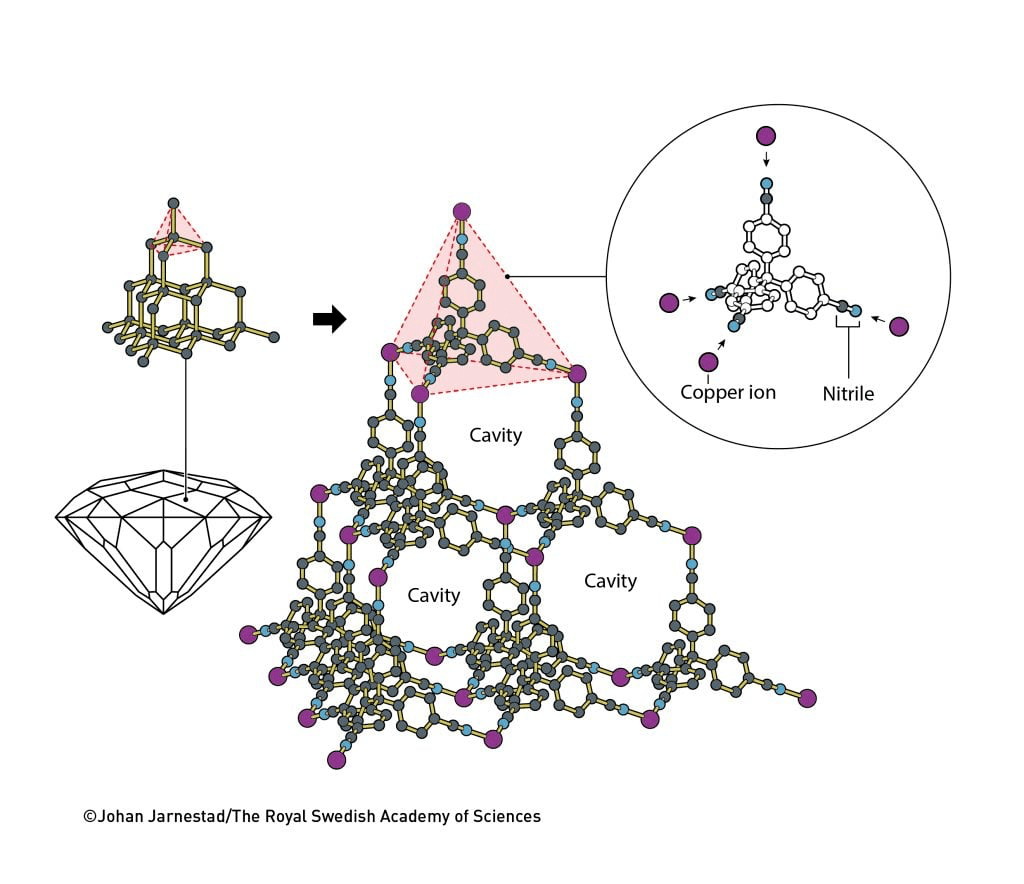
Kitagawa further developed this idea, where using the cavities within these molecules, he fitted metal ions together like a 3D puzzle, where long 3 dimensional channels were created with the conjoining of cavities. This structure could hold chemical substances such as gases stably. Going beyond, Kitagawa demonstrated that MOFs could be constructed with many different kinds of molecules that offer a variety of functions, and are pliable and flexible structures, not hard or rigid. Further developed, MOFs would alter shape flexibly when holding specific materials, and return to its original structure when emptied.
Yaghi proved the versatility and applicability of MOF by creating 16 different variations of the existing MOF-5. From collecting water in the desert to storing fuels for RNG vehicles or storing toxic gases required for the developed of semiconductors, the usage of MOF is increasing rapidly in countless industries.
Final Thoughts
The Nobel Prizes seem to value not only how fascinating or interesting the discovery itself is, but also the tangible impacts that these discoveries can have in the real world, whether its through propelling the development of technologies or the potential to create safer, more stable treatments to a disease. Nobel Prize-winning works truly advance humanity in that it pushes the boundaries of natural physical sciences, the fundamental basis of all technological, medicinal, infrastructural developments in the world, and thus the implications can be applied to many different fields. It is amazing that we are celebrating the decades worth of work of scientists who are driving humankind and society forward.
Sources: https://www.nobelprize.org/prizes/physics/2025/popular-information/
https://www.nobelprize.org/prizes/medicine/2025/popular-information/
https://www.nobelprize.org/prizes/chemistry/2025/popular-information/
 Scientific Narrative
Leave a comment