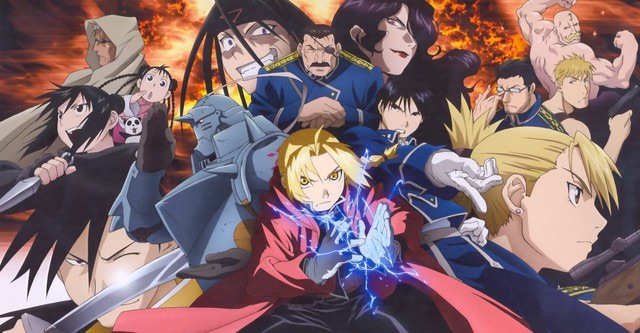
This article’s been sitting in my drafts for quite some time but here it is!
If you’ve ever read or watched the Fullmetal Alchemist series, you probably remember how the Elric brothers lost their body parts after their failed attempt in performing the forbidden taboo of “human transmutation” to bring back their mom. But… why? Why did they fail so miserably?
Let’s look beyond the fact that Fullmetal Alchemist is a work of fiction: alchemy isn’t real and it’s impossible to bring back the dead. But it gives the readers and audience much room to think about what humans fundamentally are, through creatively exploring the relationship between the biochemical makings and the conscious essence of humans.
Before we begin, spoiler alert for those who haven’t watched FMAB yet!
In the Fullmetal Alchemist universe, the human body, spirit, and mind are separate entities. The body is the biological and chemical makeup of the human. To reconstruct their mom’s body, the brothers prepared water (35L), carbon (20kg), ammonia (4L), lime (1.5kg), phosphorus (800g), salt (250g), saltpeter (also known as potassium nitrate, 100g), sulfur (80g), fluorine (7.5g), iron (5g), silicon (3g) and little amounts of 15 other elements.
The spirit acts an attribute of individuality, composing the characteristics, the personal and emotional identities of every human, while the mind bridges the divide between the physical body and the individual spirit. The body and spirit are usually united, even under unique circumstances like the separation of Alphonse Elric’s body and spirit. The body and spirit constantly attract one another through the connection that an individual’s mind provides.
Anyone who performs human transmutation like Edward and Alphonse meet Truth. A fundamental principle of the series, the law of equivalent exchange outlines that in order to gain something, something else of equal value must be given up. As the immeasurable, unique value of the human spirit outweighs that of any physical manifestation, the spirit of a dead person cannot come back alive. Despite its impossibility, Truth demands, regardless, a tremendous sacrifice from the alchemist, such as significant parts of their body, in exchange for their efforts to bring back the dead.
When the Elric Brothers tried to resurrect their mom, Edward lost a leg and Alphonse lost his entire body, just for their mom to be reconstructed into a mutilated mix of body parts of different people. A central theme of the series follows the guilt and helplessness of the Elric Brothers as well as other performers of human transmutation after their futile efforts to bring back their most loved ones.

Alphonse’s emaciated physical body lies behind the closed doors of Truth, while Edward swears to come back to and rescue this gaunt apparition of Alphonse.
The three-piece composition of human life raises the question of what defines the state of being alive for beings like Alphonse who live without a physical representation but only by the spiritual and mental fragment of self and consciousness touch upon the universal curiosity and mystery of humankind of what the ultimate human experience is. Is the human Alphonse defined by his memories of the past and sensible emotions towards the people around him? Is he not human but a moving metal mechanism by his lack of a physical state?
Truth is revealed to be a godlike entity of the universe that enforces the Law of Equivalent Exchange, taking whatever is most valuable to the alchemist, as a price for their attempt at human transmutation. Edward loses his left leg in his initial attempt to bring back his mom, only to lose his right arm soon after while retrieving Alphonse’s soul and binding it to his iconic armor. Only when Edward sacrifices all his metaphysical ties with alchemy, years worth of knowledge and experience in the field, is Alphonse able to regain his body in its entirety, while Edward, despite alchemy having been his greatest skill, can never perform alchemy ever again.
Hiromu Arakawa points out the limitations to the reductionist, purely technical approach to defining life and its meanings. There’s much overlooked and missed when we fixate on the numbers, components, and ingredients. There’s more to be earned, felt, experienced that cannot be quantified or conceptually defined. Truth lies beyond the equivalent transactions that seem to govern our everyday lives, whether that’s through money, laws, or pursuit of ambitions. The balance of knowledge with humanity is what fulfills our lives, what makes our hearts fullmetal.
This message seems especially pertinent in an era where scientific discoveries and technological advancements are made expeditiously. Whether its gene editing, AI, weapon development, the ethics as to how it will impact others, the humanitarian implications of technology must be emphasized and considered.
Popular media’s exploration of human life and consciousness brings both the philosophical and scientific questions to the table for discussion. It’s always very refreshing and enlightening to explore scientific and philosophical topics through the perspective of a creative mind.
Big thanks to Hiromu Arakawa for the amazing series and the FMA Fandom page for the detailed lore used in this article!
Happy New Years everybody!
 Scientific Narrative
Leave a comment