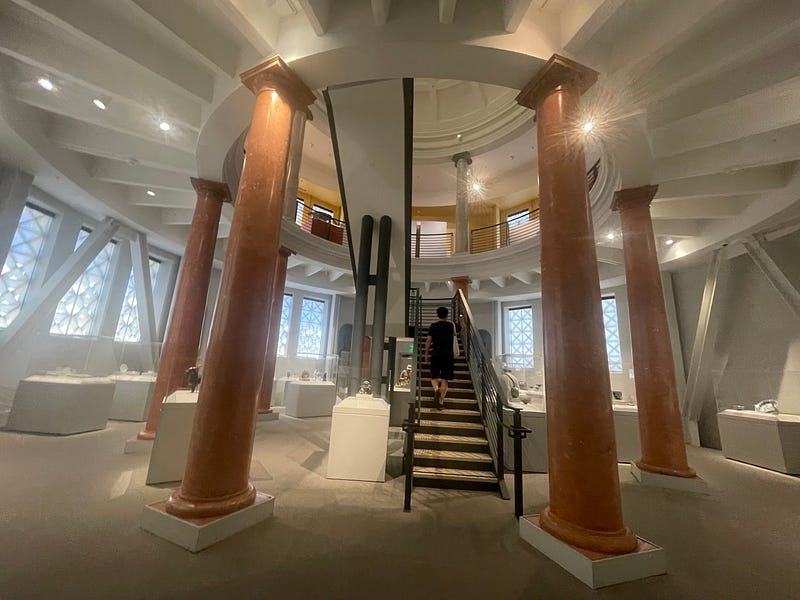
I visited the Cantor Arts Center at Stanford University this afternoon. Among the collections of artworks from all across the world, I lingered in the circular room of Asian pottery and ceramics in the warmly lit first-floor gallery. How they ended up across the ocean in San Francisco, CA is a whole different— and greatly upsetting — story for another time.
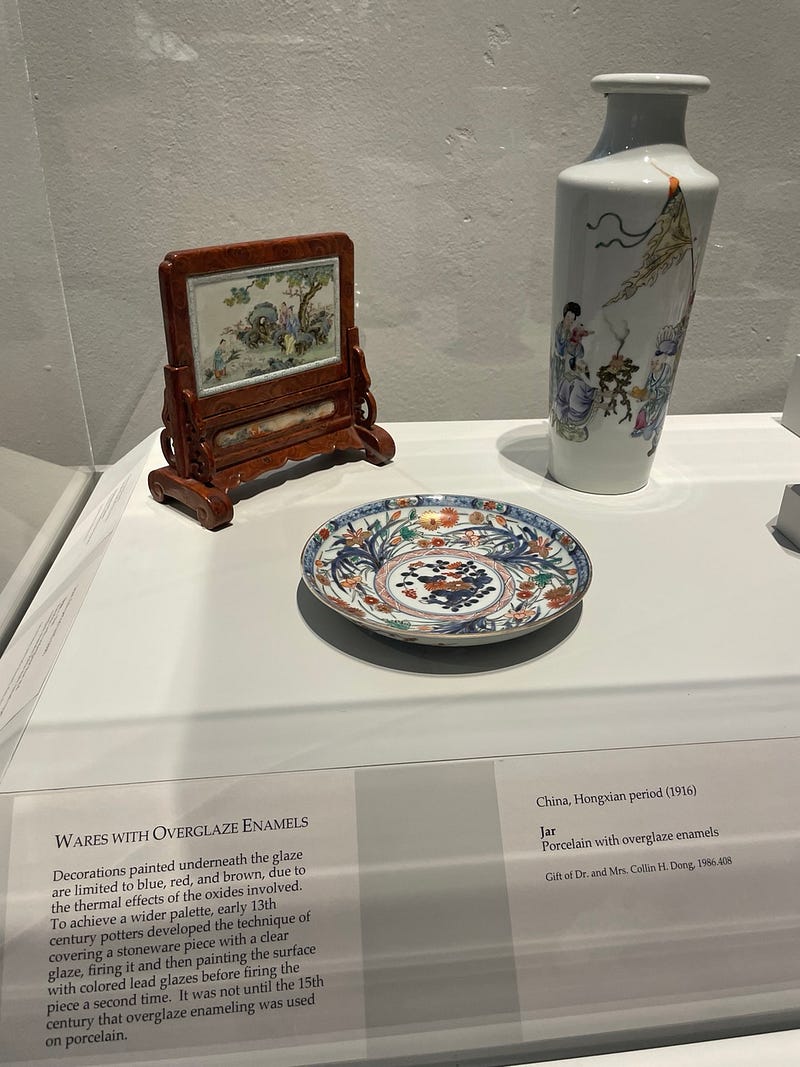

What caught my eye were the perfectly preserved, rich, vibrant colors of the artifacts, despite many having been created multiple centuries ago. Although the origins of each spanned from China to Korea, Japan to Vietnam, I read a plaque about overglaze enamels, and the technological limitations of the time that prompted its application.
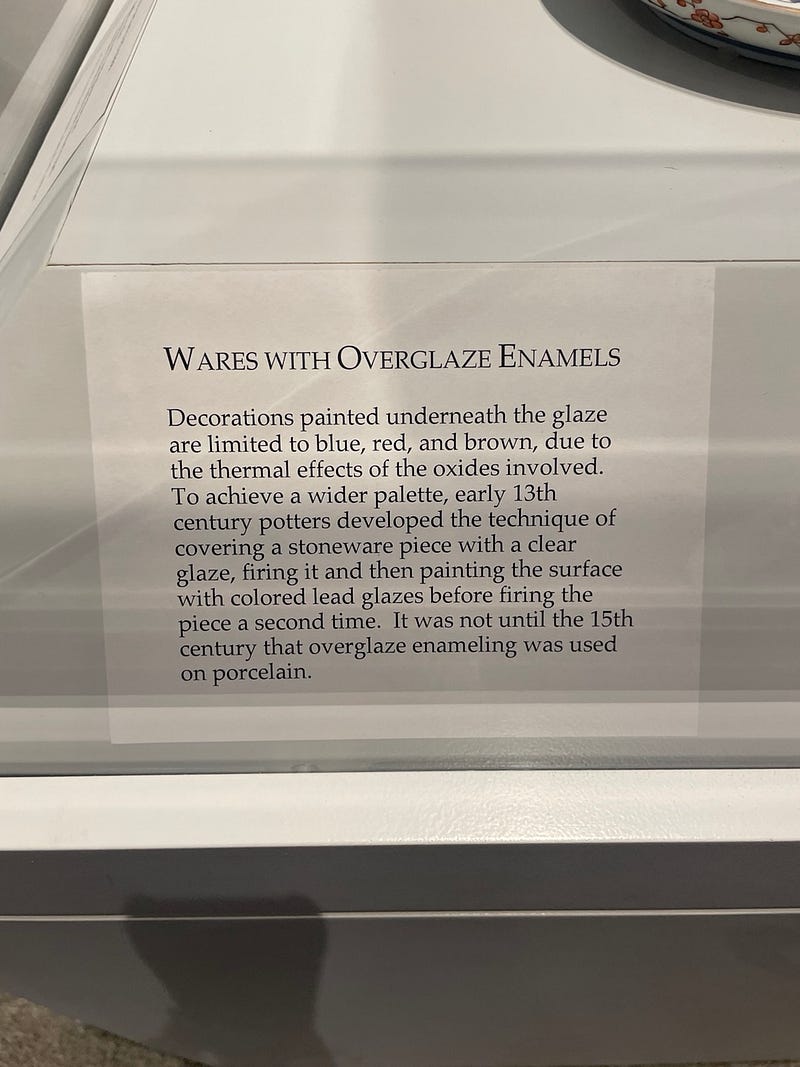
According to the plaque, colors that worked directly on ancient Asian stoneware pottery were restricted to red, blue, or brown, due to chemical reactions with oxides during the firing process that made it impossible for other colors to show. Eventually, potters in the early 13th century developed the method of overglaze enamels, where they would glaze and fire the pottery beforehand, then apply the colors, and finish off by firing the surface again afterwards. This allowed a wider variety of colors to be able to be presented on pottery, and in the 15th century, these techniques were used on porcelain as well (Cantor Arts Center).
How were the artifacts I saw so timelessly preserved? The Si-O and Al-O bonds that most pottery and enameled works are made of have very high melting points, ranging from 500~1500 degrees Celsius, enabling the ceramic works to endure centuries and even millennia in their stable chemical structures (Ph Colomban).
On a molecular level, what does overglazing enamels really do? The grain and material a ceramic piece is made of affect its heterogeneity. In contrast, the homogeneous, amorphous, or glassy nature of enamels means enamels have a very low level of heterogeneity. Through firing the ceramic piece for the first time, it enables more active chemical reactions to happen on the surface of the pottery and helps form a solid layer when cooled afterwards. On top of this newly created thin layer, potters have to use more pigments during the coloring step, and after the second firing, the colors appear more vibrant, literally due to the higher quantity of chemicals applied on the surface while coloring (Ph Colomban).
I hope to look into thermochromism in more depth. The interaction of temperature, chemical material, and light was so fascinating to see on the little, fragile surface of ancient potteries.
Sources:
Cantor Arts Center, Stanford University
Ph Colomban. Polychrome enamels, ceramics, glasses and their degradation. Analytical Stratégies for Cultural Materials and their degradation, J.M. Madariaga Ed, RSC, pp.255–282, 2021, 978–1–78801- 524–0. ffhal-03622861f (https://hal.science/hal-03622861v1/document)
 Scientific Narrative
Leave a comment