

“All things are poison and nothing is without poison; only the dose makes a thing not a poison.” – Paracelsus, 1530s.
At Barnes and Nobles, I found an eye-catching beauty of a book, titled Poison: The History of Potions, Powders, and Murderous Practitioners by Ben Hubbard. If you know me, you’d know that I’m currently obsessed with an anime series called The Apothecary Diaries, a mystery romance about the 17-year-old apothecary Maomao, who goes around solving palace mysteries and saving people using her knowledge of herbs and the natural sciences. The moment I saw this book, I did exactly what Maomao would’ve done; I snatched off the book and stuck my nose deep in.
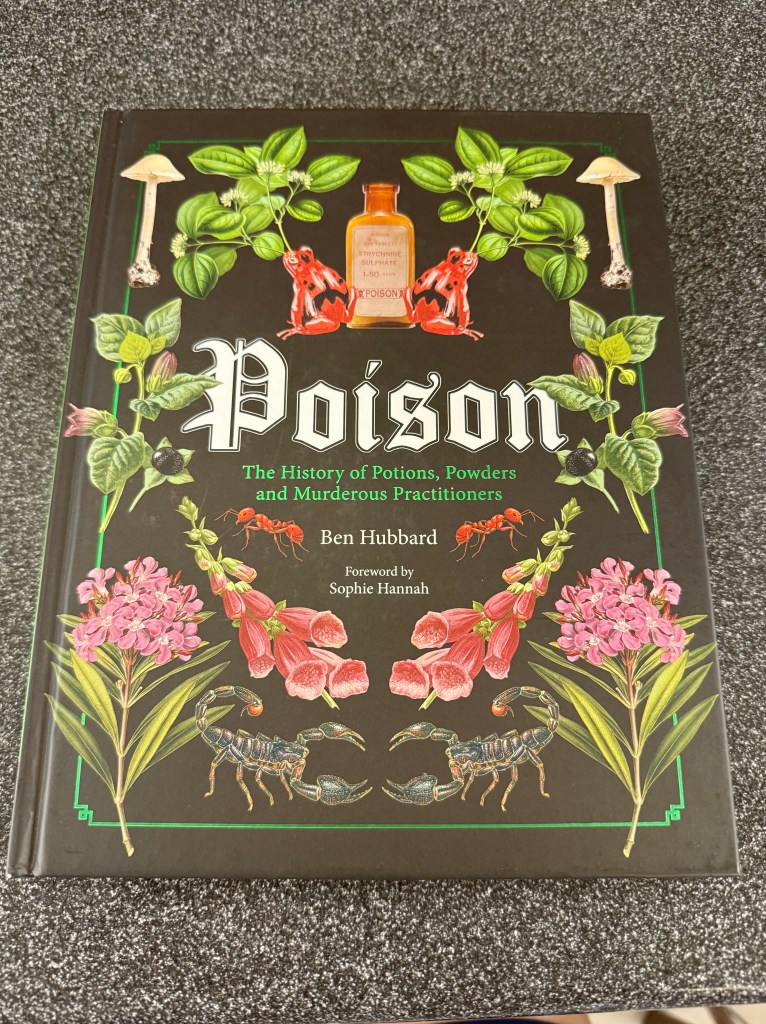
Hubbard emphasizes head on that the line between medicine and poison is blurry, with the dosage primarily determining the effect on the user. He mentions that once the poison infiltrates your body system and comes into your bloodstream, it wreaks havoc from a cellular level. With many breaking into the cell’s membrane, poisons can damage DNA and RNA, obstruct enzymes, cut off energy supplies of cells, and so on.
Historically, poisons have been used for their ability to silently kill targets. Due to their deceptively and unassumingly violent nature, their usage is also intertwined with a history of drama, public executions, and superstitious accusations. In fact, you’d be surprised by how many historical and cultural events poisons are associated with. One of my favorites is the story of Giulia Tofana. An Italian woman of the 17th century, she supplied acqua tofana to miserable wives under the disguise of a cosmetics business. Because these women had such limited rights and voices in society, were victims of domestic abuse and couldn’t divorce their husbands, some of them wished to become widows, and acqua tofana proved potent. Symptoms of aqua tofana were similar to those of terminal diseases, and thus could raise almost no suspicion of deliberate poisoning. Contemporary analysis states its symptoms seem to indicate a composition of arsenic, and possibly belladonna, antimony, lead, and cantharidin as well. Eventually, Tofana’s covers were blown by one of her clients, and she was dishonorably executed. Although a serial killer, Tofana tried to subvert societal oppression and help out desperate wives in her own twisted way. We need a movie about her.
I felt like an apothecary myself when I read about different kinds of plants, animals, and substances that are commonly found poisons, including hemlocks, aconites, and opium. Next to very detailed, beautiful drawings were gruesome, flinch-inducing descriptions on their toxic effects, symptoms, and famous poisoning instances. Get this: “Aconite poisoning causes the heart to beat abnormally by sabotaging the pumps that move sodium ions in and out of the heart’s cells. By binding to these pumps, the poison holds them permanently in an “on” position […] This is followed by asystole, the most serious form of cardiac arrest, which is usually irreversible.” (Hubbard, 37) It’s frightening how such an unassuming, innocent looking plant can chemically and irreversibly obliterate fundamental bodily functions.
If you know me, yet again, I would like to know more about specific biochemical interactions that cause poisons to debilitate, tear apart cells and body systems, while being the same substance as many potent medicines. How exactly does dose affect the effects of these chemicals, and why does it, if they are of the same substance?
It’s quite poetic and eerily beautiful; the same substance can either save or ruin you. Maomao, if you’re reading this, you have my respect. Medicine is no joke.
 Scientific Narrative
Leave a comment